Category: Rooted for Care

  • T is for Tend Consistently — Make It a Way of Life

    T is for Tend Consistently — Make It a Way of Life

    Lasting change doesn’t come from one breakthrough.

    Watch how the ROOT Method makes consistent self-care sustainable and straightforward.

    T is for Tend Consistently.

    The ROOT Method ends with daily, doable care—because healing isn’t a single act.
    It’s a relationship.

    Tending is about returning.
    Over and over.
    With compassion.
    With presence.
    With grace.

    It’s how you stay rooted.

    What tending consistently looks like:

    • A few minutes of breathwork before bed
    • Moving your body because it feels good
    • Saying “no” without overexplaining
    • Journaling when the mind spirals
    • Letting rest be part of the rhythm

    Consistency is not perfection.
    It is presence, repeated.

    Try this today:

    Choose one tiny practice you can repeat this week.
    Anchor it to something you already do—like brushing your teeth or making tea.
    Let it be enough.

    The ROOT Method ends with this truth:
    The way you tend to yourself shapes the way you meet the world.


    Why consistency matters in the ROOT Method

    Many people think self-care requires hours or expensive retreats. However, the ROOT Method reveals that daily micro-practices yield the most significant shift. Whether it’s a single mindful breath, a gentle stretch, or journaling one line, tending consistently builds resilience.

    Consistency turns tools into habits, and habits into a lifestyle. That’s how you transform stress management into steady, embodied calm.

    Related reading:


    Start tending today with the 5-Day Calm Reset.

    If you’re ready to try this with guidance, join the free 5-Day Calm Reset.

    • Daily breathwork or movement cues
    • Simple affirmations to anchor steadiness
    • Practices that fit into your real life—even in your chair

    Start now — it’s free and powerful


    Stay rooted in consistency.


  • O is for Organize Your Energy — Create Calm On Purpose

    O is for Organize Your Energy — Create Calm On Purpose

    Awareness and choice mean little without structure.

    Discover how the ROOT Method teaches you to organize energy with intention.

    O is for Organize Your Energy.

    Once you recognize your patterns and own your response, it’s time to create conditions that support the life you want.

    This step is about alignment.
    It’s not about squeezing more in.
    It’s about clearing what no longer fits.

    Organizing your energy means:

    • Choosing how you spend your time
    • Setting boundaries without guilt
    • Honoring your capacity instead of pushing past it
    • Designing routines that match your nervous system—not just your to-do list

    Your energy is a resource.
    When you organize it with intention, you stay rooted—even in chaos.

    Try this today:

    List three energy leaks in your day.
    Now list three energy boosters.
    Ask yourself: What’s one shift I can make this week to support my nervous system?

    The ROOT Method reminds us: calm isn’t random. It’s designed.
    Next step: T is for Tend Consistently.


    Why organizing your energy matters.

    Stress often comes from scattered focus and overcommitment. By organizing your energy, you create a structure that keeps you grounded and resilient. This step of the ROOT Method empowers you to make intentional choices that align with your values, reduce overwhelm, and protect your nervous system.

    Related posts:


    Start organizing your energy with the 5-Day Calm Reset.

    If you’re ready to try this with guidance, join the free 5-Day Calm Reset.

    • Daily breathwork or movement practices
    • Practical affirmations for calm and clarity
    • Easy tools you can use anywhere—even in your chair

    Start now — it’s free and powerful


    Stay rooted, stay organized.


  • O is for Own Your Response — Shift from Powerless to Present

    O is for Own Your Response — Shift from Powerless to Present

    Once you recognize the pattern, you face a choice.

    Learn how to own your response and return to calm with the ROOT Method.

    O is for Own Your Response.

    This doesn’t mean you caused everything that happened.
    It means you choose how you show up now.

    Owning your response is self-respect in action.
    You don’t wait for others to fix it.
    You stop outsourcing your calm.
    You decide: What’s my next best move?

    Here’s what it can look like:

    • I feel overwhelmed → I take a 2-minute pause.
    • I feel dismissed → I name what I need.
    • I feel frozen → I move my body gently.
    • I feel angry → I breathe before I speak.

    Owning your response puts you back in the driver’s seat. It’s how you shift from powerless to present.

    Try this today:

    When something irritates or drains you, pause.
    Say to yourself: “I choose to respond with awareness.”

    You are not your reaction. You are the one who responds—with presence, practice, and power.
    Next: Organize Your Energy.


    Why “Own Your Response” works.

    Stress builds up when we react on autopilot. Owning your response interrupts the cycle. It activates nervous system regulation, clarifies needs, and guides the next step. In the ROOT Method, this step turns awareness into aligned action.

    Related posts:


    Build the habit with the free 5-Day Calm Reset.

    If you’re ready to practice this with support, join the free 5-Day Calm Reset.

    • Daily breathwork or movement (10 minutes or less)
    • Simple prompts to shift from reaction to response
    • Tools you can use anywhere—even in your chair

    Start now — it’s free and powerful


    Stay rooted, stay present.


  • R is for Recognize — Awareness is the First Move

    R is for Recognize — Awareness is the First Move

    Before anything can change, you have to see what is.

    R is for Recognize.

    This step is about shining a light on the patterns, triggers, and stories running beneath the surface—without shame or sugarcoating.

    Most of us run on autopilot.
    We override, avoid, or numb.
    We say we’re fine when we’re exhausted.
    We cope instead of connecting.

    Why Recognition Matters.

    Stress, anxiety, and burnout often come from ignoring the early signals. The ROOT Method begins with recognition because you can’t reset what you refuse to name. By seeing clearly, you step out of autopilot and back into choice.

    Recognizing means you pause to ask:

    • What’s going on?
    • What am I carrying that no one sees?
    • What pattern keeps repeating?

    You can’t reset what you won’t name.
    Recognition brings clarity.
    And clarity brings choice.

    Try This Practice Today.

    Take 3 minutes.
    Write down one story or behavior that’s been showing up lately.
    Then ask: Is this protecting me or limiting me?

    This step isn’t about blame.
    It’s about understanding.

    The ROOT Method begins by helping you see yourself clearly—so you can stop spiraling and start shifting. Next: Own Your Response.


    Benefits of Recognition.

    • Reduces overthinking by naming what’s real
    • Creates space between trigger and response
    • Improves emotional awareness and resilience
    • Supports nervous system regulation

    When you recognize patterns, you stop repeating cycles unconsciously. That’s where change begins.


    Start with the Free 5-Day Calm Reset.

    If you’re ready to practice recognition with daily support, join the free 5-Day Calm Reset.

    • Quick daily practices (movement or breath)
    • Prompts to help you pause and notice
    • Simple tools you can use anywhere—even in your chair

    Start now — it’s free and powerful


    Stay Rooted in Awareness.


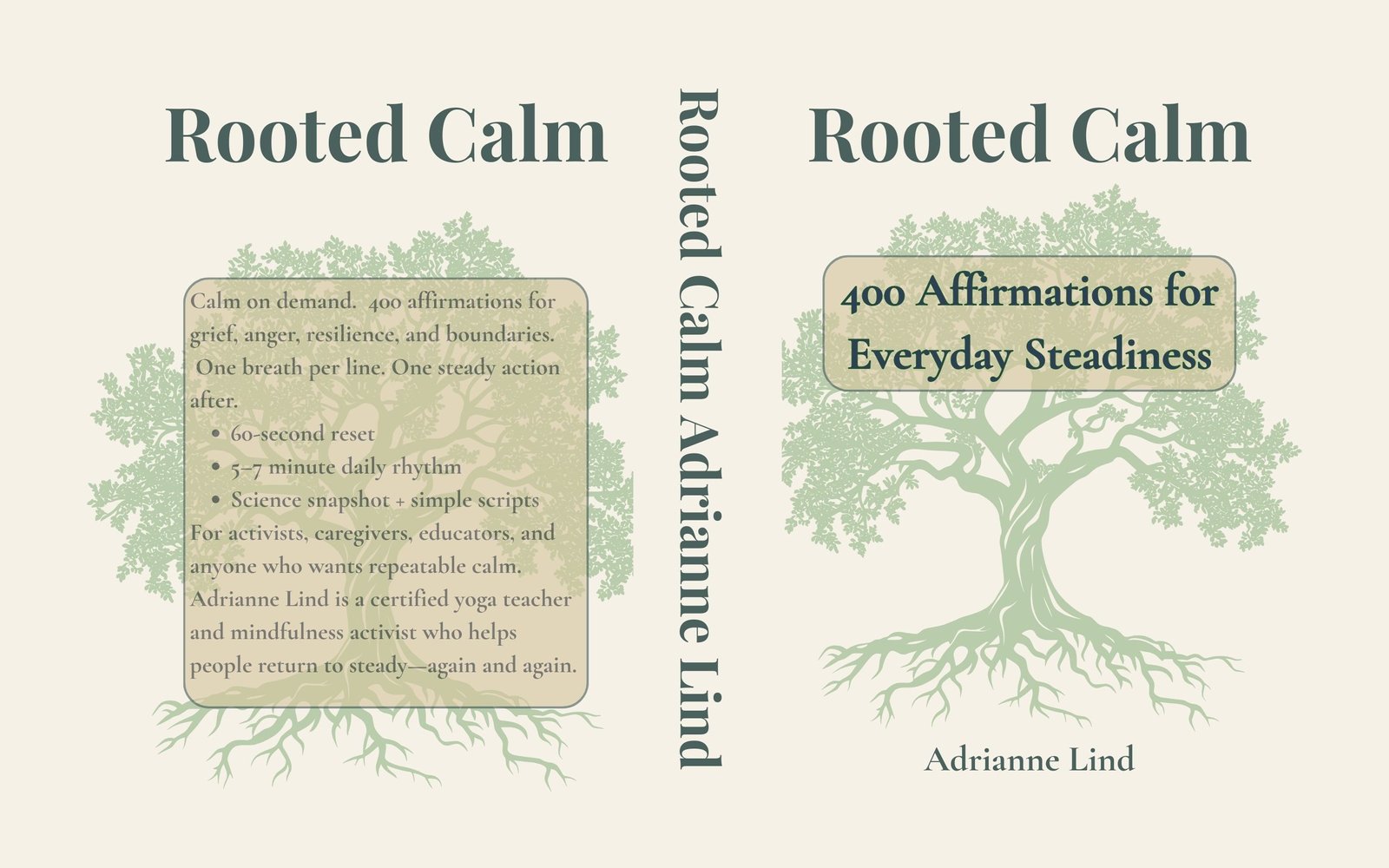
  • New Book! Rooted Calm 400 Affirmations

    New Book! Rooted Calm 400 Affirmations

    for Everyday Steadiness

    Calm on demand.
    One breath per line.
    One steady action after.

    What This Book Gives You

    • 400 concise affirmations for everyday steadiness
    • Four themed chapters: Grief, Anger, Resilience, Boundaries
    • A 60-second reset practice you can use anytime
    • A 5–7 minute rhythm for daily grounding

    Who Rooted Calm Is For

    • Activists, caregivers, educators, clinicians
    • Anyone who wants repeatable calm in under 5 minutes
    • Readers looking for practical tools for stress, grief, anger, and boundaries

    How to Use It

    • Pick one theme for the week
    • Read 3–5 lines aloud
    • Breathe 4 in / 6 out as you read
    • Take one small intentional action

    Practice at a Glance (60 Seconds)

    • 0–10s: Plant feet. Lengthen spine. Unclench jaw, hands, stomach
    • 10–25s: Exhale to empty. One round: inhale 4, exhale 6
    • 25–45s: Read one line slowly. Repeat once
    • 45–60s: Do one action—schedule, text, sip water, or step outside

    Why It Helps

    • Short, precise affirmations train attention and behavior
    • Pairing words with slow breathing supports nervous system regulation
    • Simple routines make calm, repeatable, and accessible

    Sample Affirmations from Rooted Calm

    • Grief: I let today be gentler
    • Grief: I take this breath and stay
    • Grief: I soften my pace
    • Anger: I lower my voice and hold the line
    • Anger: I pause before I act
    • Anger: I choose one clear sentence
    • Resilience: I take the smallest next step
    • Resilience: I log one win
    • Resilience: I return to steady sooner
    • Boundaries: I’m not available for that
    • Boundaries: I’ll reply tomorrow
    • Boundaries: I keep my word to myself

    Read It Anywhere

    • At your desk before a difficult call
    • In a parked car after tough news
    • Before sleep to reset your mind
    • Between meetings to stay grounded

    Formats Available

    • Paperback, eBook, and hardcover
    • Phone-friendly page design for reading on the go

    Get the Book

    Start Today

    • Read three lines aloud
    • Breathe 4/6
    • Take one steady step

    Rooted Calm book cover - 400 Affirmations for Everyday Steadiness

    About the Author

    Adrianne Lind, author of Rooted Calm

    Adrianne Lind is a certified yoga teacher (MSc, MA, BA), mindfulness activist, author, and trauma-informed yoga guide. She helps people reclaim calm with practical, repeatable tools that fit real life—her methods, CALM, CARE, and ROOT, support nervous system regulation and everyday resilience.


    Stay Connected


  • E is for Embody — Live Your Calm, Daily

    E is for Embody — Live Your Calm, Daily

    The final step in the CARE Method is where everything integrates.

    E is for Embody — Live Your Calm, Daily

    E is for Embody.

    It’s not just what you do.
    It’s how you become.

    You’ve checked in.
    You’ve activated your tools.
    You’ve practiced new patterns.

    Now it’s time to embody calm, resilience, and choice—every single day.

    What It Means to Embody Calm

    • Showing up from steadiness, not stress
    • Making space for pleasure and rest without guilt
    • Trusting your body as a guide, not a burden
    • Building rhythms that support your nervous system

    Embodying calm means calm isn’t something you reach for in crisis.
    It becomes the foundation you live from.

    Daily Embodiment Practice

    Ask yourself:
    What’s one way I can embody calm today?

    • In the way you speak
    • In what you say yes (or no) to
    • Through how you move your body
    • By how you close your day with intention

    The CARE Method is more than a toolkit. It’s a way of being—rooted, present, and practiced.


    Try the 5-Day Calm Reset

    If you’re ready to practice embodiment with guidance, join the 5-Day Calm Reset.

    Each day includes simple movement or breath cues you can do anywhere—even in your chair.
    Start now—it’s free and powerful


  • R is for Repattern — Break the Default Loop

    R is for Repattern — Break the Default Loop

    Awareness and action are powerful.
    But real change happens when you do it consistently.

    R is for Repattern — Break the Default Loop

    R is for Repattern.

    This is the third step in the CARE Method—rewiring your nervous system through repetition and choice.

    Why Repatterning Matters

    We all have default responses:

    • People-pleasing
    • Avoidance
    • Control
    • Collapse

    These patterns aren’t flaws—they’re survival strategies. But with awareness and practice, you are allowed to choose differently. And with time, you can.

    Examples of Repatterning

    • Pausing before reacting
    • Choosing a boundary instead of burnout
    • Replacing harsh self-talk with curiosity
    • Resting before the crash

    Repetition, not perfection, creates change.

    Repatterning in Daily Life

    Try this today:

    • Notice one moment, you want to rush or avoid
    • Take one slow breath instead
    • Count it as a rep. That’s how change happens

    In the CARE Method, we practice new ways of being until they become who we are. Next: E is for Embody


    Join the 5-Day Calm Reset

    If you’re ready to repattern with guidance, join the 5-Day Calm Reset.

    Each day includes movement or breath cues you can do anywhere—even in your chair.
    Start now—it’s free and powerful


  • A is for Activate Your Tools — Don’t Just Know, Do

    A is for Activate Your Tools — Don’t Just Know, Do

    Once you’ve checked in, it’s time to respond.
    That’s where the second step of the CARE Method comes in.

    A is for Activate Your Tools — Don’t Just Know, Do

    A is for Activate Your Tools.

    You already have practices that calm you: breathwork, journaling, mindful movement, music, EFT tapping, and spending time in nature. The key is to use them—on purpose, in the moment they are needed most.

    Why Activating Your Tools Matters

    It’s not enough to know what helps you feel better. You need to practice it when it counts. This is how you interrupt stress spirals, shift old patterns, and reset your nervous system in real time.

    When you activate your tools, you send a signal of safety to your mind and body. Over time, this practice builds resilience and steadiness—even when life feels chaotic.

    Simple Practices to Activate Calm

    Try one of these short, repeatable grounding techniques today:

    • Breathe in for 4, exhale for 6 to reset your nervous system
    • Shake out your hands to release stored tension
    • Write one short sentence about what feels true right now
    • Tap gently on your heart and say: “I’m safe to slow down.”

    That’s activating. Simple. Intentional. Repeatable.

    What’s One Tool You Can Use Today?

    Ask yourself: Which practice can I reach for before the stress builds? The sooner you activate, the sooner you prevent overwhelm from taking over.

    CARE Method in Action.

    In the CARE Method, we don’t wait for calm to show up on its own. We create it. We practice calm in the middle of real life—at work, in parenting, in relationships, and in everyday stressors.

    Next step in the CARE framework: R is for Repattern.


    Start with the 5-Day Calm Reset.

    If you’re ready to try this with guidance, join the free 5-Day Calm Reset. Each day includes short, simple practices—breathwork, movement, or reflection—that you can do anywhere, even in your chair.

    Start now—it’s free and powerful


  • C is for Check In — Start Where You Are

    C is for Check In — Start Where You Are

    When life feels overwhelming, the first step is to pause and take a moment to check in. That’s where the CARE Method begins.

    C stands for Check In.

    This step in the CARE Method is more than asking yourself, “How are you?”. It’s about taking an honest look—without judgment—at what’s happening in your body, mind, emotions, and spirit. Checking in is the foundation of mindfulness and stress management.

    Why Checking In Matters for Stress Relief

    Most of us live in a constant state of survival mode. We override fatigue, suppress emotions, and ignore our own needs just to keep going. Over time, this leads to burnout, disconnection, and chronic stress. By pausing to check in, you create space to notice what’s real—so you can respond with clarity instead of reacting on autopilot.

    Simple Check-In Practice.

    Try this right now:

    • Take a slow, steady breath.
    • Ask yourself: What’s happening in my body right now?
    • Notice: Where is my attention?
    • Observe: What emotions are present?
    • Reflect: What do I need?

    These four questions build self-awareness. And without awareness, you can’t choose differently.

    How to Bring It Into Daily Life.

    Action step: Set a 2-minute timer today. Close your eyes, breathe, and ask: “Where am I right now?”. Write down the answer. That’s your starting point. It doesn’t need to be polished—it just needs to be true.

    Checking In Builds Emotional Resilience.

    The CARE Method isn’t about fixing yourself. It’s about listening. When you check in, you learn to meet your body and mind where they are instead of pushing past your limits. Over time, this consistent practice increases emotional resilience, supports nervous system regulation, and creates a foundation for calm in everyday life.

    Small check-ins can have a significant impact on your stress levels. Next step: A is for Activate Your Tools.


    Join the 5-Day Calm Reset.

    If you’re ready to deepen your practice, join the free 5-Day Calm Reset. Each day includes simple breathwork, movement, or journaling cues you can do anywhere—even in your chair.

    Start now—it’s free and powerful


  • M is for Move What You’re Holding

    M is for Move What You’re Holding

    Movement is How We Heal What Words Can’t Touch

    Sometimes you don’t need to talk it out; you need to move it out. The body keeps the score, and often stress, trauma, and unprocessed emotions get stored in muscles and tissues.

    Your body stores emotions in places like:

    • Clenched shoulders from constant tension
    • Tight hips from sitting and holding stress
    • Jaw pain or headaches from unspoken words

    When you move intentionally, you release more than stiffness. You clear emotional tension and reset your nervous system. This isn’t about burning calories—it’s about releasing stress and restoring balance.

    Simple Daily Practices to Release Stress

    Here are a few quick ways to begin moving what you’re holding:

    • Shake out your arms before bed to reset your body for rest
    • Do cat-cow stretches while seated to release spine and hip tension
    • Practice 2 minutes of alternate nostril breathing to balance energy and calm your mind
    • Take a mindful walk, swinging your arms freely to clear stress

    Small movements create powerful shifts. Even 1–2 minutes of intentional practice can reduce stress, improve mood, and increase resilience.

    Why Movement Supports Emotional Healing

    Movement regulates your nervous system. When you allow your body to express what words can’t, you build resilience and emotional steadiness. Over time, this consistent practice helps reduce anxiety, release stored emotions, and cultivate inner calm.


    Join the 5-Day Calm Reset.

    If you’re ready to release stress and embody calm, join the free 5-Day Calm Reset. Each day gives you a simple movement or breathwork cue you can do anywhere—even sitting in your chair.

    Start now—it’s free and powerful